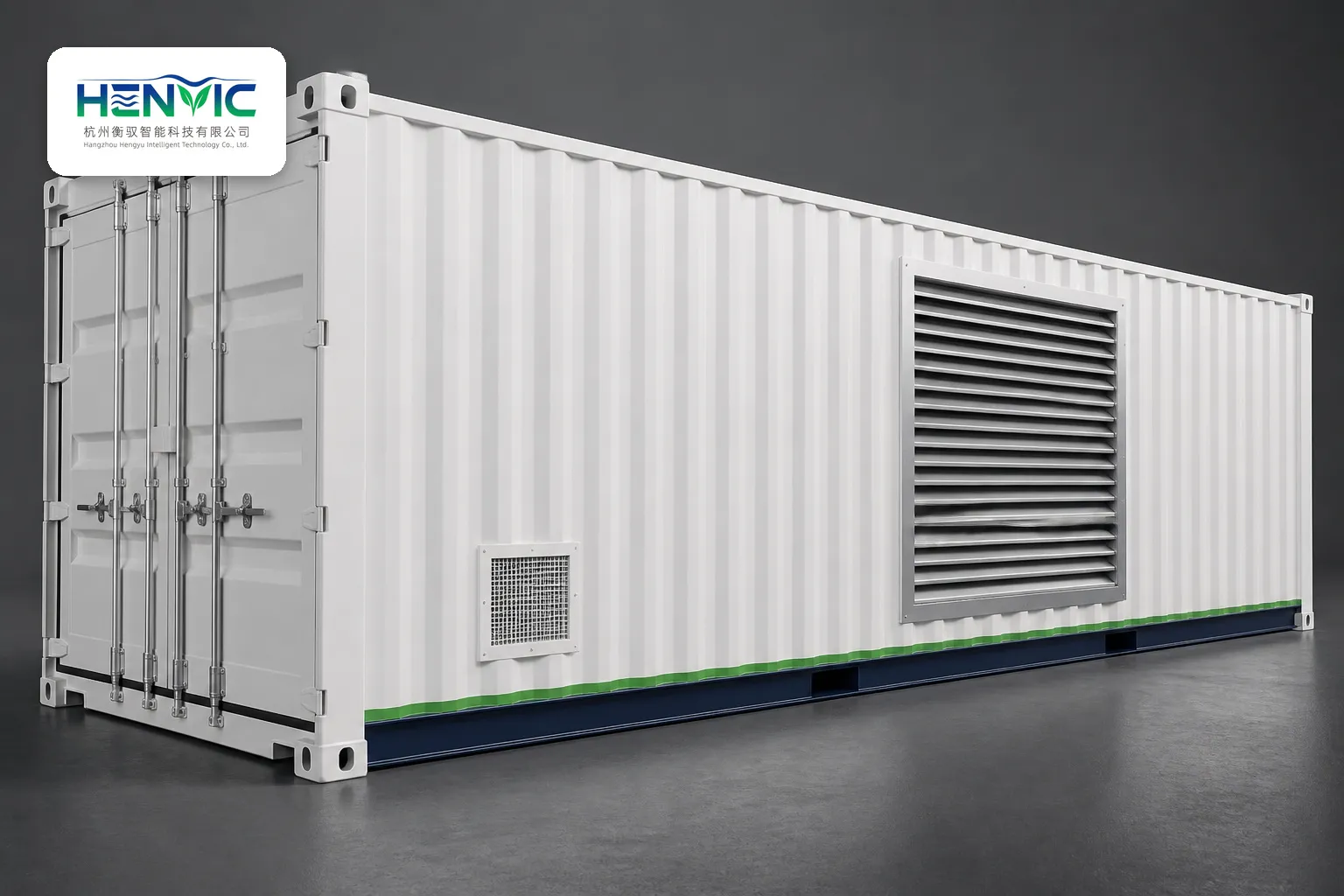
Container-grown leafy greens have now been demonstrated in conditions that no greenhouse could survive — inside a desert where outside air exceeds 50 °C, on a Canadian site in deep winter, and aboard ocean-going research vessels — and in the more commercially meaningful setting of a Chinese vegetable hub that exports the equipment itself to thirteen countries. The most useful thing about these cases is what they reveal about where the format actually wins: not against open-field agriculture on cost per kilogram, but in stressed environments where the alternative is no fresh produce at all, and in markets where 30 square metres of footprint can substitute for 150 square metres of farmland.
The cases below are drawn from local government releases, regional media and operator statements. Figures are as reported by those sources.
Case 1 — Shouguang, Weifang: The Container as an Export Product
Origin. Xiangtian Agricultural Technology Co. (翔天农业科技有限公司), based in Jiatai Town, Shouguang, built its container plant factory by looking at idle shipping containers and asking why they could not become growing space. An R&D team spent two years solving the temperature-control, supplemental-lighting and nutrient-circulation problems; the first unit was exported to Europe in 2019.
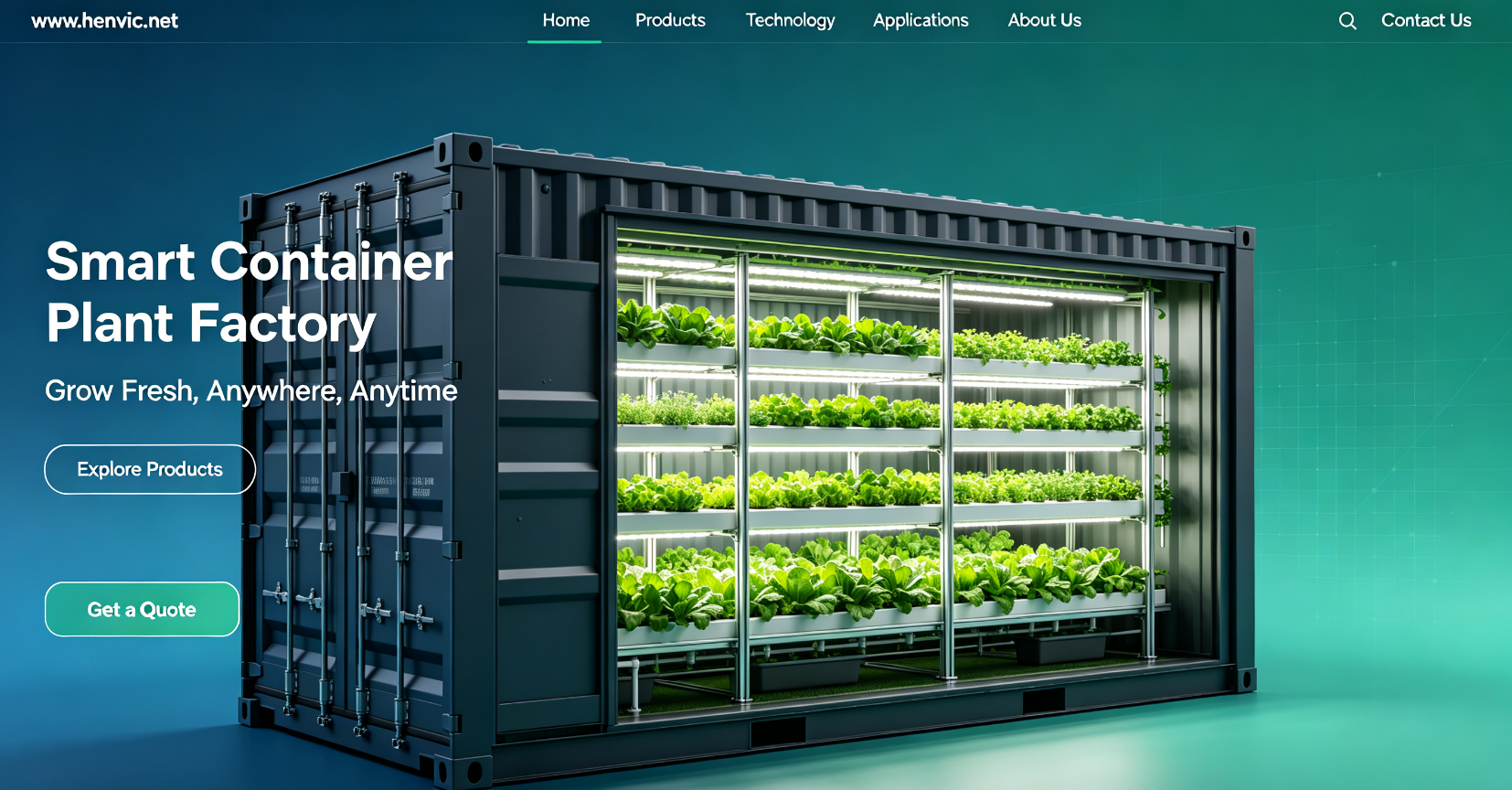
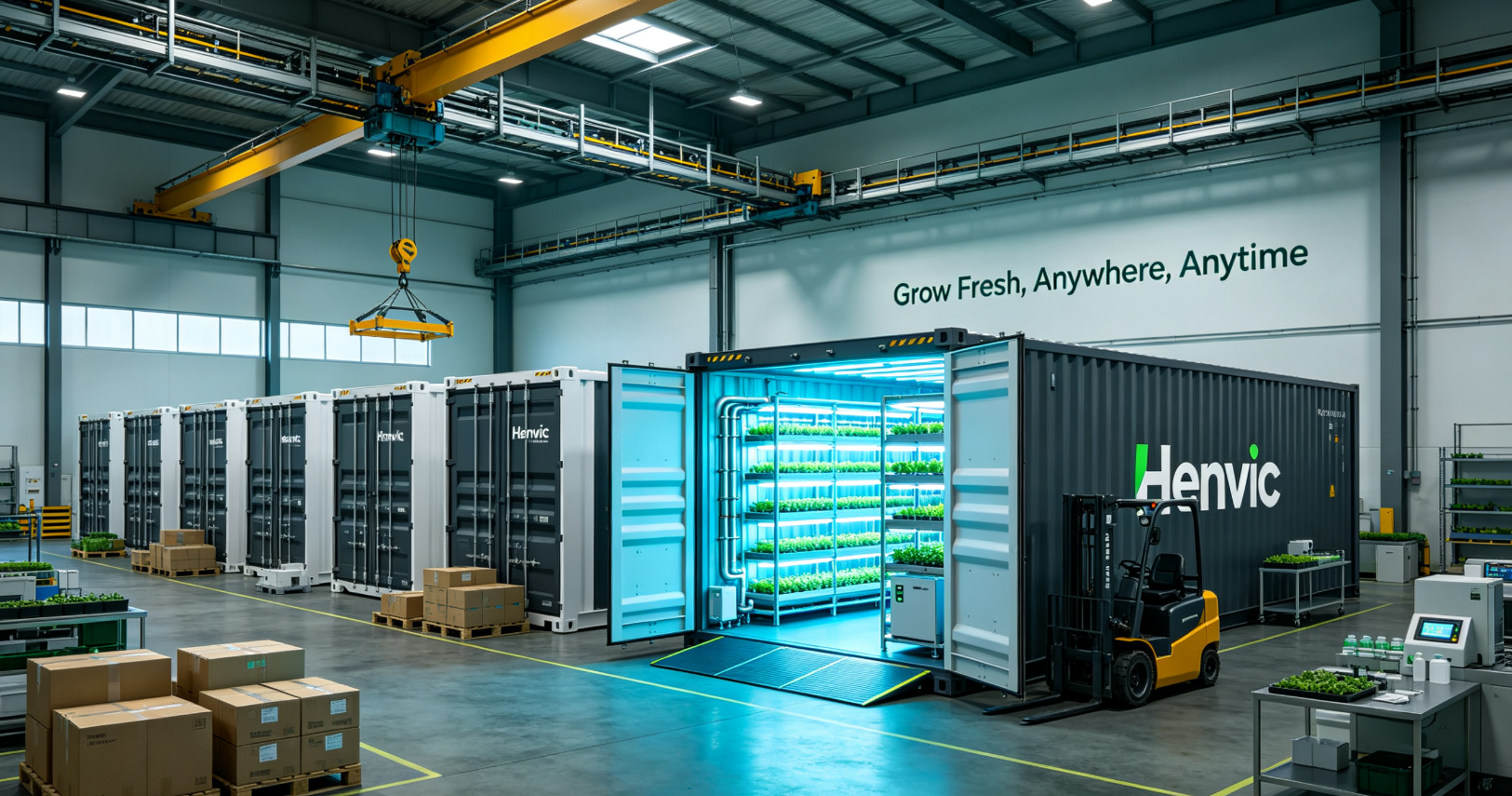
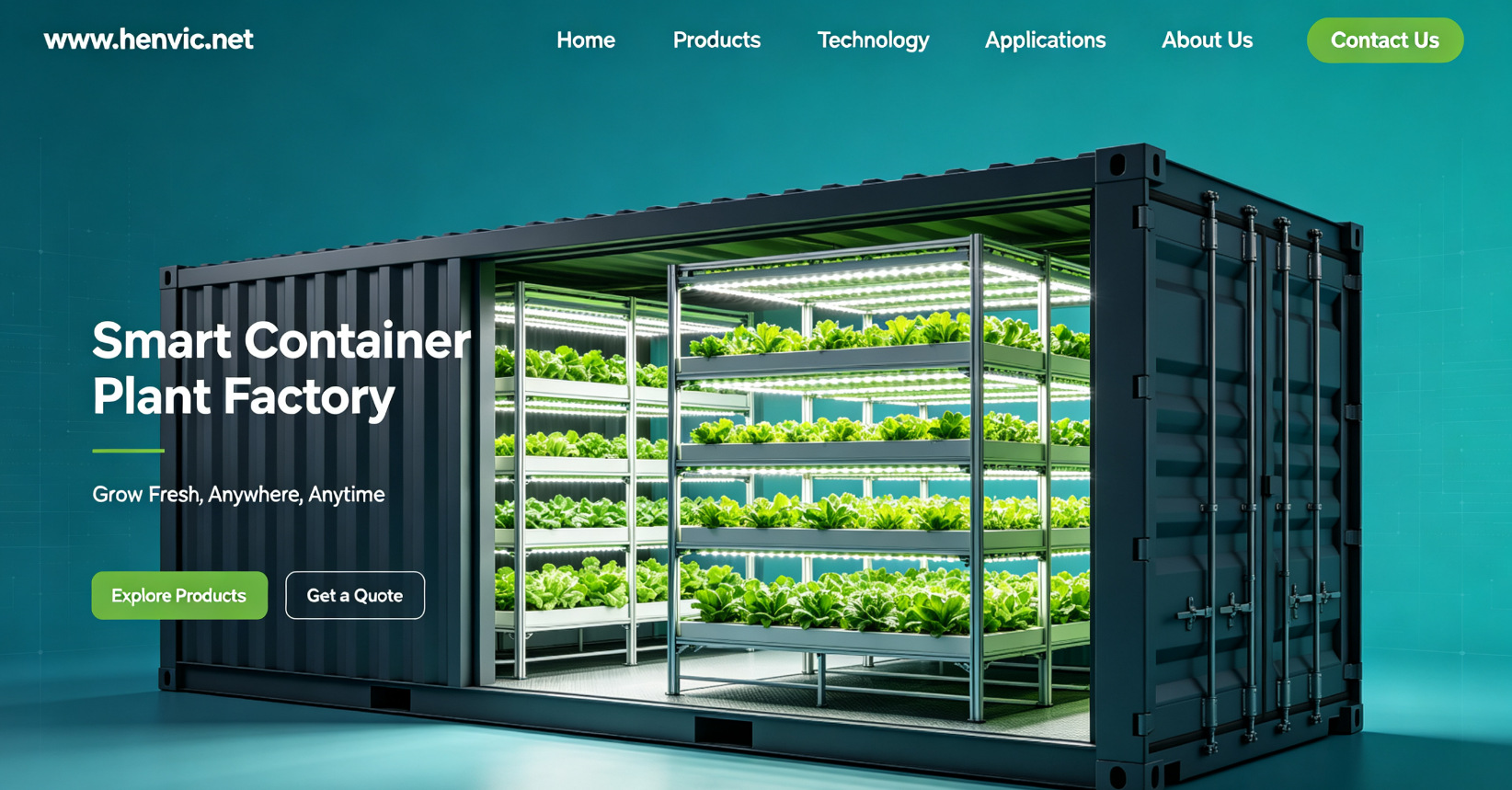
Configuration. Multi-layer three-tier cultivation racks sit inside a standard container shell. LED arrays replace sunlight and are tuned in wavelength and duration per crop. A "breeze circulation" system imitates natural wind to drive gas exchange and transpiration. A custom nutrient solution replaces soil and is delivered by an integrated water-and-fertiliser unit directly to the root zone, which the operator frames as eliminating pesticide residue and soil contamination rather than merely saving water. Precision sensors monitor temperature, humidity and light around the clock.
Reported performance. The headline numbers are the footprint ratio and the cycle time. A container with a base area of just over 30 square metres supports a cultivation area equivalent to more than 150 square metres of flat farmland, and delivers roughly five times the productivity of conventional planting. Crop cycles for the vegetables grown — from mushrooms and leafy greens to fruiting vegetables — run 25 to 30 days from establishment, close to half the time of conventional open-field growing. For lettuce specifically, one container raises more than 2,000 plants per batch and yields 8 to 10 harvests per year — on the order of 16,000 to 20,000 heads annually from a footprint smaller than a small apartment.
Where it has been deployed. This is the distinguishing feature of the case. The units are described as solutions for regions where conventional growing is impractical — extreme cold, extreme heat, and land-scarce island nations — and have been exported to the United Arab Emirates, Canada, the Netherlands and a reported thirteen countries in total. In the UAE desert, the container withstands outside temperatures above 50 °C while producing fresh leafy greens; in Canada's severely cold regions, the envelope insulation and intelligent temperature control keep crops growing through conditions that would end outdoor production. Units have also gone aboard Chinese polar research vessels, functioning as an at-sea vegetable garden for crew on long deployments far from any resupply. The company's stated next target segments are island garrisons, remote mining areas and disaster-response situations.
Why it worked. Shouguang's competitive position was never the container itself — it was the surrounding vegetable industry: seed breeding capability, an established horticultural knowledge base, supply chains for nutrients and equipment, and a brand that opens export doors. The container is the productised output of that ecosystem, and the export success is better understood as technology transfer from a mature vegetable cluster than as a container-farming breakthrough. The commercial logic of the destination markets is also self-evident: a unit that produces fresh greens at 50 °C ambient, or through a Canadian winter, is not competing against cheap field lettuce — it is competing against trucked-in or airfreighted produce at a severe price and freshness penalty.
Case 2 — Shanghai and Chongming: Water, Taste and the Public-Sector Case
Chongming, Guangming Mugang park. Ten containers stand on the lawn of the Guangming Mugang park in Chongming, Shanghai. Reported outcomes: water consumption roughly 90% lower than conventional cultivation, better-tasting vegetables, and product that can be eaten directly without washing concerns. LED lighting controls the spectrum and photoperiod. This is the clearest published articulation of the format's resource argument in a Chinese municipal context — not land scarcity, which Shanghai does have, but water efficiency and ready-to-eat safety, which are the two attributes that justify a municipal or institutional buyer paying a premium.
The Shanghai Academy of Agricultural Sciences programme. Separately, the Shanghai Academy of Agricultural Sciences' leafy-vegetable industry technology system has been built around what it describes as intelligent empowerment and green production, aimed at maintaining stable local supply of leafy greens and shifting the local industry from "supply security" toward "quality and efficiency." This matters as context for the Chongming deployment: in Shanghai, leafy greens are treated as a public-supply category with a research and technology infrastructure behind it, not purely as a commodity crop. That is precisely the policy environment in which a container plant factory's higher cost per kilogram can be socially justified.
Ocean-going deployment — the "Dayang" and "Xin Guanghua" cases. Two separate vessel deployments are documented. The 4,000-tonne global-class comprehensive resource survey vessel Dayang completed a voyage and docked at Shekou in Shenzhen, where the container in its deck space was found full of leafy greens — a Shanghai-developed containerised, closed plant factory that the coverage describes as allowing crew to grow vegetables in a "foolproof" manner, letting seafarers on long missions harvest fresh produce themselves. Separately, on the COSCO vessel Xin Guanghua, crew harvested from four-layer soil-based cultivation racks holding 81 planting trays, growing lettuce, Shanghai greens (qing cai), bok choy, lettuce and oilseed rape leaves at sea.
Why it worked. These deployments are not evaluated on cost per kilogram, and should not be. The alternative on a long ocean voyage or a polar station is either no fresh vegetables or produce that has degraded through weeks of storage. A container that keeps a crew supplied with palatable, vitamin-bearing greens is worth its capital cost on morale, nutrition and voyage logistics grounds alone. This is the purest form of the value proposition: the container does not need to beat field agriculture, only to beat the supply chain that would otherwise serve that location — which in these scenarios is extremely expensive or nonexistent.
Case 3 — Shenzhen Community Deployment
A vertical agriculture installation in a Shenzhen community is recorded among the format's demonstrated applications, used for local fresh production in an urban setting, with the standing framing that high land prices in city environments make the footprint economics decisive. The full operational figures from that deployment were not retrievable at the time of writing, so it is noted here for the direction of its claim — that the container's density advantage is the entry argument in urban China, where land cost per square metre is the dominant constraint on any food-production business.
What the Cases Have in Common
The value proposition is environmental substitution, not agricultural efficiency. Every case that reports a genuine win does so in a location where conventional production is impossible, severely costly, or badly served by logistics: a 50 °C desert, a Canadian winter, a polar research ship, an ocean voyage, a dense urban district, a land-scarce island. None of them reports out-competing open-field vegetable farming on unit cost. This is the single most important pattern in the evidence, and it defines the addressable market.
The footprint ratio is the mechanism. Xiangtian's "30 square metres of base area equal to 150 square metres of farmland, at five times the productivity" is the whole commercial case in one sentence. The container's value is that it makes a specific quantity of output available in a location where the equivalent field area does not exist or costs far more per square metre than the container does. The ratio, not the yield, is what is being sold.
Cycle compression makes the model schedulable. Reported harvest intervals of 25–30 days across the crop range and 8–10 leafy harvests per year mean the operator is running a predictable production calendar rather than a seasonal one. That is what permits contracts, staffing plans and continuous supply obligations.
Water efficiency is a first-class selling point, not a footnote. The reported ~90% water saving in the Chongming deployment is a compliance and licensing asset in water-constrained jurisdictions and an operating-cost asset everywhere. It is also one of the few claims in this sector that is straightforwardly verifiable by metering.
The export path is integration, not the box. Shouguang's thirteen-country deployment record did not come from the container technology alone; it came from an established vegetable industry's seed stock, horticultural knowledge, supply chains and brand. Operators considering this format should ask what ecosystem they are attached to, because the container is commoditising while the surrounding capability is not.
What These Cases Do Not Establish
Several limitations should be stated plainly, because this format is unusually easy to over-sell.
None of the sources reviewed publishes a full economic model. Reported figures cover capacity, cycle time, footprint ratio, plant counts and water savings — not electricity cost per kilogram, labour hours per harvest, capital cost, loss rate, or net margin. Reported "five times productivity" and "90% water saving" are physical or resource ratios, not financial returns, and a resource ratio can be excellent while the business loses money on lighting and dehumidification. All figures are self-reported by operators and relayed through government communications and regional media rather than audited accounts. The converted-currency or per-head estimates are not provided in the sources.
The vessel and polar deployments are specialty applications with non-market procurement logic; their success says nothing about commercial viability in a normal urban market with normal competitors.
The two most likely failure points for a new entrant are unaddressed by any success story: HVAC sized on cooling capacity rather than dehumidification capacity (leafy greens transpire heavily, and a unit that meets temperature setpoint while humidity climbs will produce tip burn, condensation on cold surfaces and a Botrytis event), and power resilience (an NFT or aeroponic system with a small solution buffer can lose a crop within an hour of an outage in a warm climate).
A Replication Checklist
- Confirm the location genuinely justifies the capital. Desert, extreme cold, vessel, island, dense urban district, mine, disaster-response site. If the site has cheap farmland and a working cold chain, the container is the wrong tool.
- Size the HVAC for latent load at design canopy density, and ask for the dehumidification figure in litres per day, not just the cooling capacity in kW.
- Specify the footprint ratio you need — output per square metre of base area — since that, not yield per plant, is what the buyer is paying for.
- Design for cleanability: sloped wash-down floor, functional drain, cleanable rack feet and cable penetrations, light fittings not acting as contamination traps.
- Instrument both ends and two heights of the room, and control VPD as a computed value rather than temperature and RH separately.
- Establish fail-safe states for every actuator on signal loss and power loss, with pump and controller backup.
- Document the water budget including condensate handling, solution exchange and wash-down — because the ~90% saving claim only holds if the system is metered and the losses are managed.
- Secure the offtake before the first harvest. The export and institutional cases all had a committed buyer or a captive population; a container without a channel is a very expensive hobby.
- If exporting, verify electrical certification and refrigerant handling requirements for the destination jurisdiction in writing, with model numbers.
- Check the ecosystem you sit in — seed and seedling supply, nutrient logistics, technical service, spare-part lead times for lamps, drivers and compressors.
On evidence: the case material in this article is drawn from the Shouguang Municipal People's Government release of 1 December 2025 and the Shouguang Rongmedia report carried by The Paper on 16 December 2025 (Xiangtian Agricultural Technology container plant factory); Dazhong News / People's Daily Online (Shandong) coverage of 5 July 2025 and Shanghai-based reporting on the Dayang deployment; Shanghai Chongming District Government reporting of 1 November 2023 (Guangming Mugang container installation); and operator and industry-trade coverage of containerised leafy-green systems generally. Figures are site-level and self-reported, and are not presented here as audited performance data. Capacity, cycle-time, footprint-ratio and water-saving figures are physical and resource metrics, not profitability metrics. Food-safety, electrical, refrigerant and produce-safety obligations differ by country, state and destination market and are revised over time — confirm against the current requirements of the relevant authority before building, exporting or making a market claim. No vendor endorsement or market-size figure is asserted here.