A mushroom container is, from a contaminant's perspective, close to an ideal habitat. It is warm during colonisation, humid throughout, rich in organic substrate, dark, and closely packed. It is also a monoculture: one species, one substrate, one environment, replicated across the entire volume. When a competitor establishes itself, it does not have to compete with ecosystem diversity; it has to compete with a single crop that has no defence.
Mushroom cultivation is therefore a discipline of exclusion, and in a container the exclusion must be architectural as much as operational. The small volume and recirculated air that make climate control possible also make contamination spread rapid and complete.
The Recognised Antagonists
Green mould species, particularly Trichoderma, are the most common and most destructive contaminants in substrate-based cultivation. They colonise substrate rapidly, produce copious green spores that disperse through air circulation, and can outcompete mushroom mycelium during the colonisation phase, when the crop has not yet established dominance.
Cobweb disease, caused by Cladobotryum, appears during fruiting as a white, rapidly spreading mycelial growth over the substrate surface and over developing mushrooms themselves. It thrives in the cool, humid conditions of the fruiting chamber — the same conditions the crop requires.
Bacterial blotch, caused by Pseudomonas species, produces brown lesions on cap surfaces and is strongly associated with free water on the mushroom tissues and with poor airflow. It is a hygiene and climate problem rather than a substrate problem.
Beyond these, a range of other moulds, yeasts and bacteria can colonise a wet, warm surface, and the ones that matter most in practice are frequently the ones that are already resident in the facility rather than the ones arriving from outside.
How Contamination Enters
Four pathways account for most contamination events. The substrate itself can carry competitive organisms if sterilisation or pasteurisation is incomplete, or if the sterile workflow is breached after treatment. Incoming air carries spores continuously, which is why filtration matters. Personnel and equipment moving between zones move contamination mechanically, particularly when the same staff handle both spent blocks and fresh inoculation. And the container structure itself can harbour organisms in insulation, seals, drains and inaccessible crevices, re-seeding every subsequent batch.
The last of these is the most intractable, because it is invisible until it manifests as a recurring pattern rather than a single incident.
Architectural Separation
The single most effective contamination control measure in a mushroom container is dividing the facility into zones with different cleanliness requirements and physical separation between them.
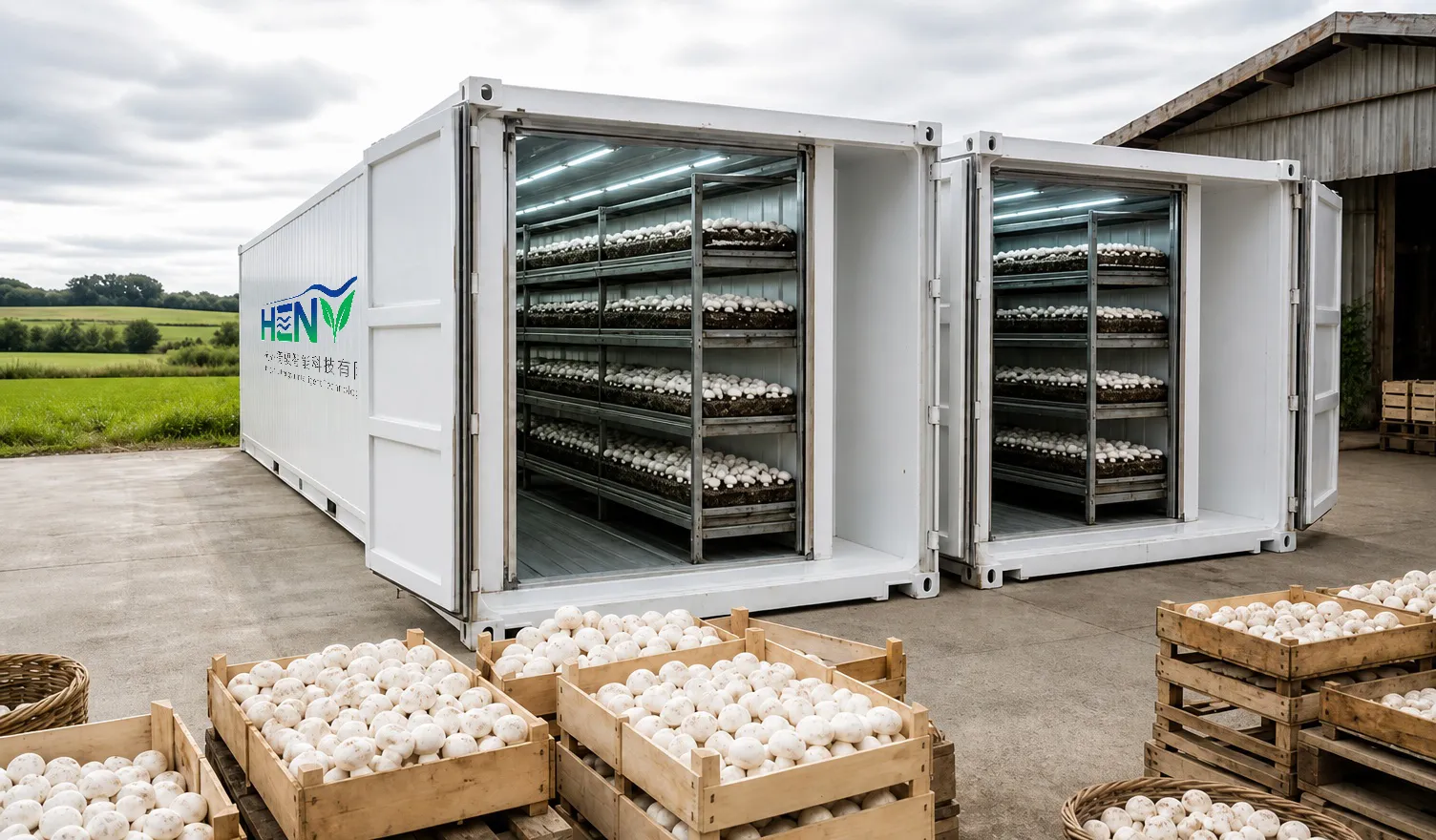
Colonisation is warm, humid, dirty, and generates a high spore load. Fruiting is cool, clean and comparatively slow to establish. These two environments should not share air. In a single-container operation this is difficult; in a multi-container operation it is straightforward, with dedicated containers for each phase and materials moving between them under controlled conditions.
Within a container, the layout should establish a clean end and a dirty end. Fresh substrate and inoculated blocks enter at one point; spent substrate and waste leave at another, by a different route if possible. Operators should not walk from spent material directly into clean inoculation areas without a change of protective clothing.
Air Handling as a Barrier
Positive pressure, maintained by supplying slightly more filtered air than is exhausted, ensures that any leakage moves outward rather than inward. This is the standard principle of clean-room design, and it is worth applying in a mushroom container even though the cleanliness class required is far below pharmaceutical standards.
Supply air should pass through high-efficiency particulate filtration rated for the spore sizes in question. The filtration must be maintained; a filter loaded beyond its design pressure drop will pass air around its seals rather than through the medium, which defeats the purpose silently.
Exhaust air should also be filtered in facilities where spores are a concern, both to prevent contamination spread between zones within the site and because mushroom spores are an occupational health issue independent of crop hygiene.
Airlocks and Movement Discipline
An airlock or vestibule at the entry to the growing volume is a modest capital addition that produces substantial benefit. It provides a space for changing protective clothing, for staging materials, and for interrupting the free flow of air and debris that follows a person walking directly in from outside.
In practice, the habits matter as much as the hardware. Dedicated footwear or footwear sanitisation, hand hygiene, clean garments changed at defined intervals, tools reserved per zone, and a defined direction of material flow all reduce contamination pressure more reliably than any single piece of equipment.
Cleaning Between Cycles
Contamination control is only as good as the reset between batches. Emptying the container completely, removing all spent substrate and organic debris, and sanitising all surfaces is the baseline. Deployment of a vaporised or fogged disinfectant achieves coverage of surfaces that hand-applied cleaning cannot reach, including the underside of racks, ductwork and coil faces.
The critical detail is that the coil is a major harbourage point. It accumulates organic debris, operates in a wet condition, and provides a warm surface during periods between cycles. A coil that is not cleaned is a persistent reservoir. The same applies to condensate trays and drainage lines, which should be sloped, accessible and flushed as part of every reset.
Monitoring and Traceability
Contamination events should be treated as data rather than accidents. Recording which batch, which zone, which phase and which environmental condition coincided with an outbreak builds a picture over time of where the weakness in the system lies. It is common to find, after several months of records, that the same rack position or the same transition point between phases accounts for a disproportionate share of losses.
Periodic environmental sampling — surface swabs and settle plates in defined locations — provides an early warning that a colony is establishing before it appears as a visible defect in a harvested crop.
The Occupational Dimension
Mushroom spores, particularly those of oyster species, are recognised respiratory sensitisers, and prolonged exposure in a confined space without protection can produce allergic reactions in workers. This is not a marginal consideration to be deferred until after commissioning. Exhaust filtration, adequate air exchange during harvesting, respiratory protection of appropriate grade, and rotation of duties where exposure is highest all belong in the facility design.
Contamination control in a mushroom container is not a matter of buying a sterility guarantee. It is the accumulation of many small architectural and procedural decisions — zone separation, pressure differentials, filtration, drainage, cleaning access, movement discipline — each of which is individually modest and collectively decisive.