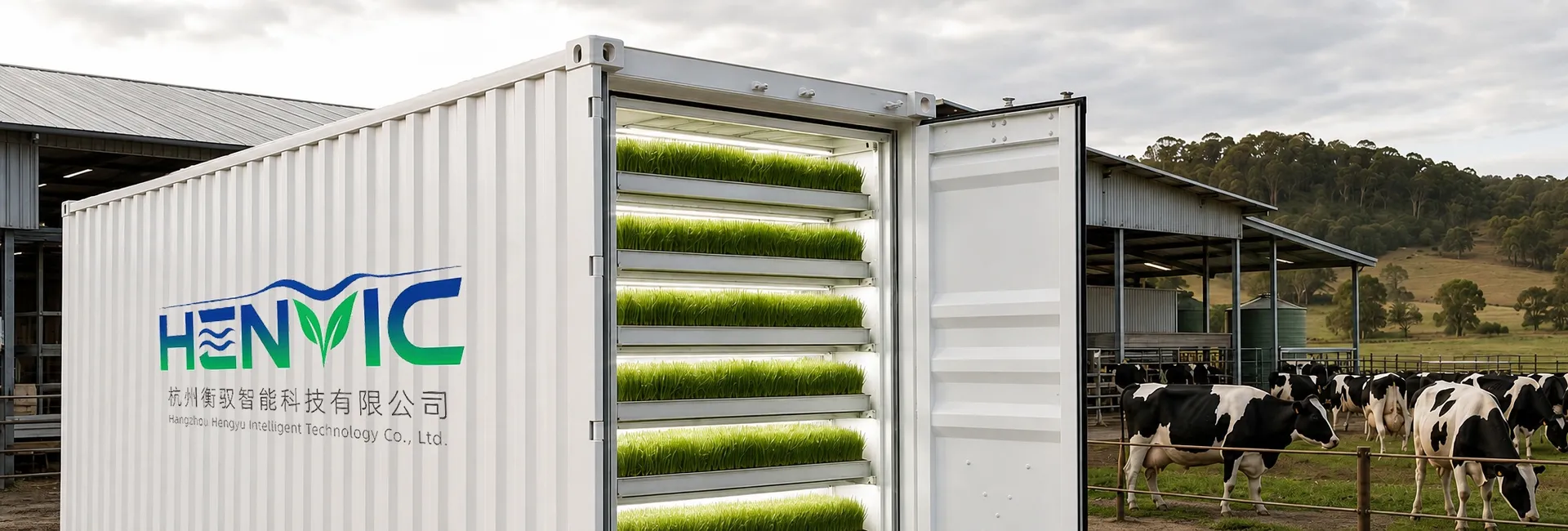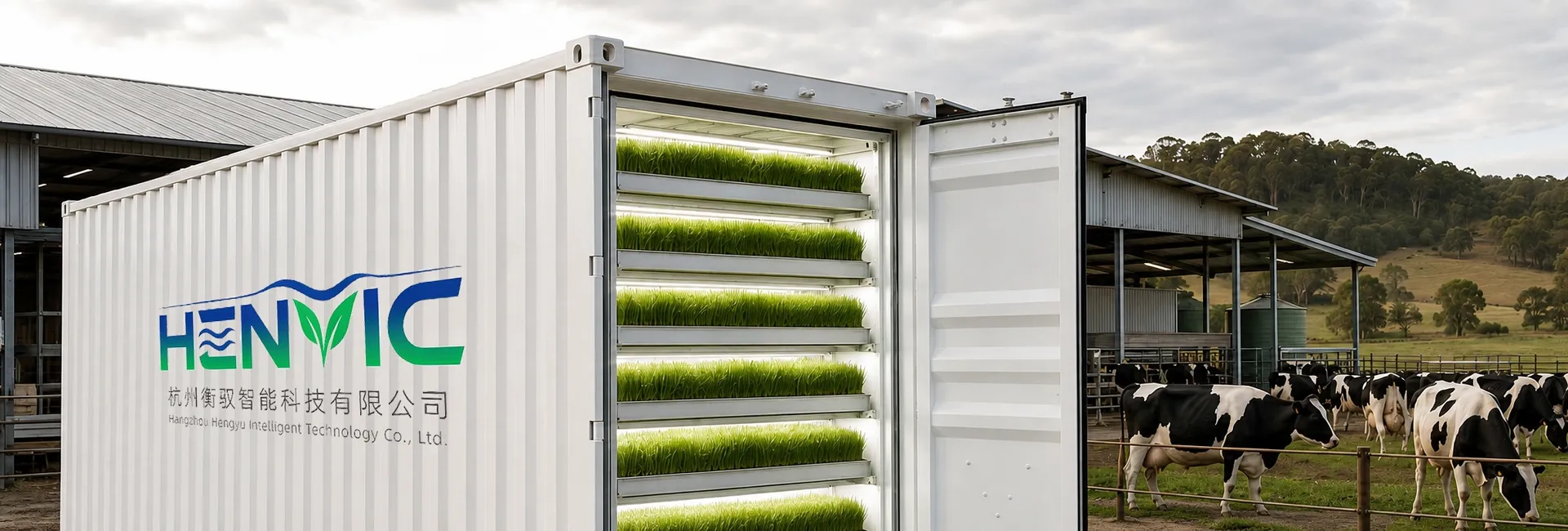
A container farm is often described as a farm without soil or sunlight. That is accurate and unhelpful. What the box actually is, in engineering terms, is a photosynthesis factory: a sealed volume in which three subsystems — an artificial light source, a recirculating nutrient delivery system, and a climate control plant — are coupled so tightly that each one's design constrains the others. The loop is the product. LEDs alone grow plants; LEDs, hydroponics and climate control designed as one system grow them at a cost that can be defended.
The Light, and Why Spectrum Is an Economic Decision
Inside a sealed container there is no sun, so every photon is purchased. That single fact makes lighting the defining economic variable of the whole system.
The relevant metric is not wattage but photosynthetic photon flux density — PPFD, the number of photosynthetically active photons landing on a square metre per second, measured in micromoles. Leafy greens typically want somewhere between 150 and 250 µmol/m²/s for economical production, delivered over a photoperiod of around 16 to 18 hours. Push intensity higher and growth accelerates, but with diminishing returns: the marginal kilogram costs more than the ones before it, and the electricity line grows faster than the revenue line.
Spectrum is a second lever. Chlorophyll absorbs most strongly in the blue and red bands, which is why early installations used the notorious magenta blend of red and blue diodes. Modern recipes are more nuanced: a red-dominant mixture with a modest blue fraction for morphology, plus a small amount of far-red to trigger shade-avoidance responses that stretch the canopy and increase harvestable leaf area. White diodes are increasingly used because they let growers and workers see crop problems, and because the human-visible spectrum is not wasted on the plant. The choice is not botanical preference — it is a trade between photon efficacy (micromoles per joule), crop architecture, and the ability to inspect what you are growing.
Geometry matters as much as spectrum. In a vertically stacked box, light must reach the lower tiers without being intercepted by the ones above, which fixes the lamp-to-canopy distance and hence the number of tiers a given interior height can support. This is where light design and rack design stop being separate problems.
Hydroponics, and the Discipline of Recirculation
Soil is replaced by a nutrient solution, delivered by one of two dominant methods. Deep water culture floats plants on rafts over a slow-moving bath, giving roots constant access and buffering against sudden shifts. Nutrient film technique runs a thin film of solution down sloped channels, so roots are exposed to both water and air — efficient on water and oxygen, less forgiving of pump failure.
The recirculating loop is where hydroponics earns its place in a container. Solution flows from a reservoir through the channels, back through filtration, and returns, with pH and electrical conductivity corrected continuously. Water consumption falls to a small fraction of field irrigation, because the only losses are what the plants transpire and what leaves with the harvested crop. In a sealed box, transpired water has to go somewhere — which is where the loop closes: condensate collected from the cooling coils can be returned to the reservoir, a practice the Cyber Farmer team from China Agricultural University explicitly deployed at the Bright Food–Duoduo Vertical Farming Challenge in Shanghai, alongside cold-source integration, on the way to an industry-leading 12.25 kilowatt-hours per kilogram of lettuce.
Nutrient management in a closed loop is the harder half. Because nothing drains away, imbalances accumulate: sodium and sulphate rise, micronutrients drift, and pathogen populations, once introduced, have no exit. Recirculation saves water and fertiliser and simultaneously raises the stakes on monitoring, sterilisation and occasional controlled discharge.
Climate, and the Problem of Uniformity
The third subsystem is the one most often underestimated, because a sealed box has no weather to moderate it. Every degree of heat must be removed by machinery, and heat is not distributed evenly: lamps dump load at the top of the stack, transpiration adds latent heat and humidity throughout, and warm air stratifies. The lowest tier can sit several degrees warmer and far more humid than the top — a gradient that produces uneven growth and uneven harvest dates.
So the design problem is not cooling capacity but uniformity: airflow that reaches every canopy at the same velocity, mixing that erases vertical stratification, and dehumidification that keeps vapour pressure deficit inside a working band. Too humid and transpiration stalls, calcium fails to reach leaf margins, and tipburn ruins the product. Too dry and the plants close their stomata and stop growing regardless of how much light arrives.
This is why the two industry teams at the Chongming competition invested in air as heavily as in light. Shandong's Leaf Heroes paired an environmental linear control system with deliberate ventilation so that a sealed container still had a sunset and a breeze, harvesting heads averaging over 300 grams and one at 460. Green Leaf Vanguard removed the operator cabin entirely — a brutal simplification that freed volume for cultivation and set the field's ceiling on space efficiency: on the same footprint, 2.8 times the cultivation area of field planting.
Why the Three Are One Loop
The systems are not adjacent; they are arithmetically linked, and that is the whole point.
Light sets the growth rate, which sets the transpiration rate, which sets the latent load the HVAC must remove. More light means more cooling, so the electricity bill rises twice — once at the lamp, once at the compressor. Lighting and climate together account for the overwhelming majority of a container farm's energy use, and they cannot be optimised separately: a light recipe that maximises yield per square metre may be indefensible once its cooling penalty is counted.
Hydroponics closes the water side of the same loop. Transpired water becomes condensate on the cooling coils, condensate returns to the reservoir, and the reservoir feeds the crop that transpires again. In a well-designed box, water is nearly a closed cycle, and the cooling system is simultaneously a dehumidifier and an irrigation source.
The competition results quantify what this integration is worth. The Cyber Farmer team more than doubled cultivation area and increased output nearly sixfold over the previous edition, yet the share of energy consumed by air conditioning fell by nearly 70 percentage points — not because the compressor improved, but because the light recipe, the airflow strategy and the cold-source design were solved together. The Shanghai Academy of Agricultural Sciences team took the spatial route, developing a hanging, movable cultivation rack to raise the container's volumetric efficiency and running extensive light trials to find a low-energy recipe for lettuce; in roughly fifty days it harvested 1,680 heads weighing 299.55 kilograms from about 42 cubic metres, with more than ninety percent meeting Grade A commercial standards — the highest yield in the field.
The Loop's Honest Limits
Three constraints survive every optimisation.
Photons are invoiced. A field gets its light free and its land expensive. A box inverts this. At 12.25 kilowatt-hours per kilogram and an industrial tariff of eight to ten US cents, electricity alone costs about a dollar per kilogram of lettuce, before seed, labour or depreciation. The closed loop can make that figure smaller; it cannot make it zero, and the sector's leading results are celebrated precisely because they approach the floor of what the physics permits.
Costs scale with tiers. Unlike a field, where the second hectare is cheaper per unit than the first, each added layer needs its own lamps and its own share of cooling. There is almost no economy of scale inside a single box — only the economies that come from replicating a standardised design. That is why standardisation, not horticultural ingenuity, is the sector's central engineering problem.
Labour does not shrink with the box. Seeding, transplanting, harvesting, sanitation and monitoring are per-unit-of-time tasks, and a small container cannot absorb a full-time wage against a few tonnes of annual output. Automation is the frontier here, and it is where the next genuine cost reduction will come from rather than from better diodes.
A Factory That Has to Be Paid For, Hour by Hour
The container farm's achievement is that it turns a biological process into a controlled industrial one: light delivered as a specified photon flux, water recirculated to near-closure, climate held inside a band that keeps stomata open and leaf margins intact. The control is real, and it is why the output is clean, consistent and schedulable in a way field agriculture can never be.
But a factory is only as good as its cost per unit, and this one buys every photon and every degree. The closed loop of LED, hydroponics and climate control is not a claim that nature has been transcended. It is a claim that nature has been metered — and the sector's progress will be measured, quite literally, in kilowatt-hours per kilogram.