A container farm can grow almost anything. That is precisely why so many fail.
The technology removes environmental limits but does nothing to remove commercial ones, and the discipline that determines success is not horticultural but financial: choosing crops whose value supports the cost structure of a sealed, artificially lit, energy-intensive facility.
The economics that constrain the menu
Container farming carries four structural costs that field agriculture does not. Capital for the container, its envelope and its systems. Electricity for lighting and climate control, which typically represents 40 to 60 per cent of operating cost. Labour for seeding, transplanting, harvesting and packing, which remains stubbornly difficult to automate for delicate crops. And the opportunity cost of the floor area, since every square metre devoted to a low-value crop is unavailable for a high-value one.
Set against these are four advantages: proximity to market, which eliminates long-haul logistics and delivers fresher product; year-round predictability, which allows contracts that field growers cannot honour; zero pesticide requirement in a sealed environment; and the ability to site production where land is expensive but demand is concentrated.
The crops that fit are those where the advantages outweigh the costs. That means fast turnover, high value per unit of volume, low profile so that vertical stacking is viable, and tolerance of the artificial environment.
Crop categories that work
Leafy greens dominate container production for good reason. Lettuce, salad mixes, spinach, kale and Asian greens have short cycles of 21 to 45 days, modest height, high value in fresh-cut and premium retail channels, and strong response to controlled conditions. They also have a high ratio of revenue to biomass, which matters because lighting cost scales with canopy area rather than with crop value.
Culinary herbs — basil, mint, coriander, dill, parsley, chives — command high prices for freshness and live-plant presentation. Basil in particular is a staple of container farms, with rapid growth and strong demand in urban food service.
Microgreens and baby greens have the shortest cycles of all, often 7 to 21 days, and exceptionally high value per kilogram. Their production is labour-intensive at harvest, but the premium can justify it, and the low canopy height makes them ideal for dense vertical stacking.
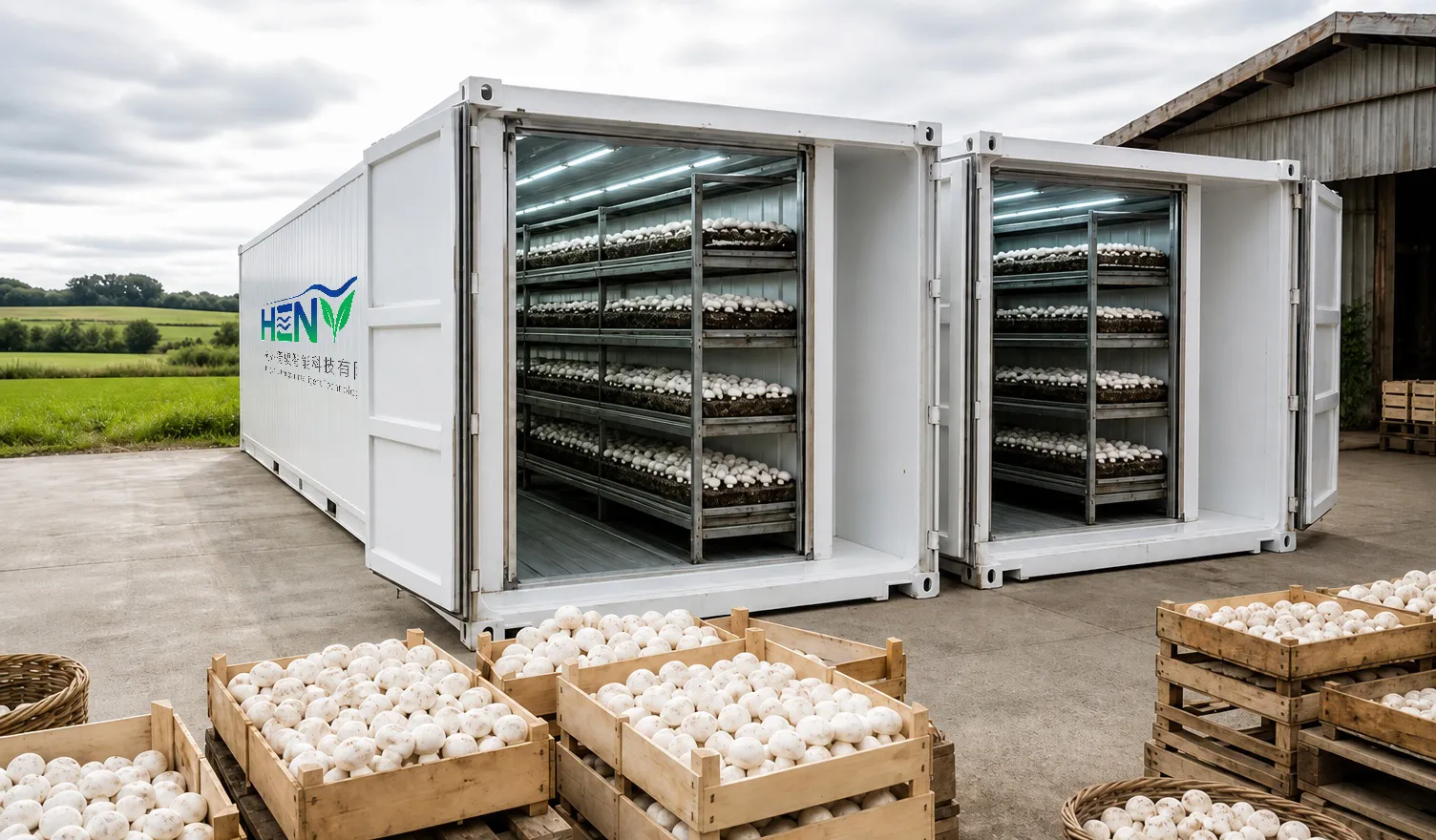
Mushrooms occupy a different technical regime, requiring dark, high-humidity conditions and a substrate rather than a nutrient solution. Oyster and shiitake varieties suit container production well, and the climate requirements of mushroom fruiting are in some ways easier to maintain than those of leafy greens.
Seedlings and transplants are an increasingly important category. Rather than growing a crop to harvest, a container farm can supply plug seedlings to field growers, ornamental nurseries or landscape contractors. The cycle is short, the product is compact, and the value proposition — consistent, disease-free, precisely timed transplants — is clear.
Crops that generally do not work
Commodity grains, root vegetables and field-scale crops such as maize, wheat, potato and carrot cannot compete with field production on cost, no matter how efficient the container. Their value per unit is too low and their space requirement too high.
Fruiting crops — tomato, cucumber, pepper, strawberry — occupy an intermediate position. Their value is high and they thrive in controlled environments, but they are tall, long-cycle and demanding of pollination and support infrastructure. Some container farms grow them successfully as premium products, but only with a clear route to market that pays for the extended cycle and reduced stacking density.
Production planning as a scheduling problem
Once the crop list is set, the operational challenge becomes scheduling. A container farm is a continuous production system, and the goal is to keep every square metre occupied by a crop at a productive stage — not by empty racks waiting for planting, or by mature plants waiting for harvest.
This is a classic job-shop scheduling problem with several constraints. Rack positions differ in light intensity, airflow and ease of access, so not every position suits every crop. Germination, propagation and finishing areas have different climate requirements. Harvest labour must be level-loaded, since a burst of simultaneous harvests creates a bottleneck and degrades quality. And the market wants consistent weekly volumes, not lumpy ones.
Practical planning tools are simple: a crop calendar showing seeding, transplant and harvest dates for each rack position; a rolling forecast of demand by product; and a rule that no rack goes empty by accident. Many farms underperform not because their yields are poor but because their density of utilisation is poor.
Yield, quality and the specification problem
Container-grown produce differs from field-grown in ways that matter to buyers. It is typically cleaner, more uniform and free of soil and pesticide residue, which is valuable in the food-service and premium-retail segments. It may also be smaller, lighter and more perishable, because it has not been bred for transport durability and because the absence of stress can produce more tender tissue.
The commercial discipline is to define the specification the market will pay for and then engineer production to hit it consistently. Uniform head weight, consistent leaf size, predictable shelf life and reliable delivery windows are worth more to a buyer than maximum biological yield. Farms that optimise for grams per square metre without reference to the buyer's specification often find they have grown the wrong thing very efficiently.
Iterating the crop mix
The crop mix should be treated as a live decision. Early production often reveals that a crop grows well but sells poorly, or sells well but ties up space for longer than its margin justifies. The farm's data — cycle length, yield per rack, labour hours per harvest, revenue per square metre per week — should drive a periodic review that moves acreage, or rack space, toward the highest-margin options.
Container agriculture is not a technology looking for a crop. It is a production method whose economics suit a specific and fairly narrow set of products, sold into specific channels. Choosing crops that fit that description is the single most consequential decision a container farm makes — more consequential, in most cases, than any equipment selection.